The following is a chronological historical reference of the battery. To improve upon batteries, it must be seen what has already been made, altered, and improved upon. This historical reference will start with the earliest known battery, the Baghdad Battery of 194 B.C., and end with the recent development of lithium cells.
250 B.C. - The Baghdad Battery
This battery was an iron rod surrounded by a copper cylinder. When filled with vinegar (or similar electrolytic solutions) it produced a 1.1 V electromotive force. Its primary function is still unknown but it is assumed to be for electroplating.
Cathode reaction: Cu2+ + 2e- -> Cu
Anode reaction: Fe -> Fe2+ + 2e-
Full redox reaction: Cu2+ + Fe -> Cu + Fe2+
 |
| Baghdad Cell diagram |
 |
| Voltaic Pile |
1800 - The Galvanic Cell (also known as the Voltaic Cell)
Named after Luigi Galvani (September 9, 1737 – December 4, 1798) or Allesandro Volta (18 February 1745 – 5 March 1827), their battery, the galvanic cell, was made out of layers of silver and zinc with salt-soaked fabric in between the two metals. The usages of the Galvanic cells are very wide and are often seen regularly.
Cathode reaction: Ag+ + e- -> Ag
Anode reaction: Zn -> Zn2++ + 2e-
Full redox reaction: 2Ag+ + Zn -> 2Ag + Zn2+
(http://www.ukbatteries.co.uk/technical/battery-info, http://www.ieeeghn.org/wiki/index.php/Alessandro_Volta)
1831 - Electromagnetic Induction
Michael Faraday (22 September 1791 – 25 August 1867) discovered Electromagnetic Induction. This allowed for generators and motors to be created giving more uses to the new battery technology. Electromagnetic Induction is still used today when using motors, generators, and turbines. (http://www.ieeeghn.org/wiki/index.php/Michael_Faraday)
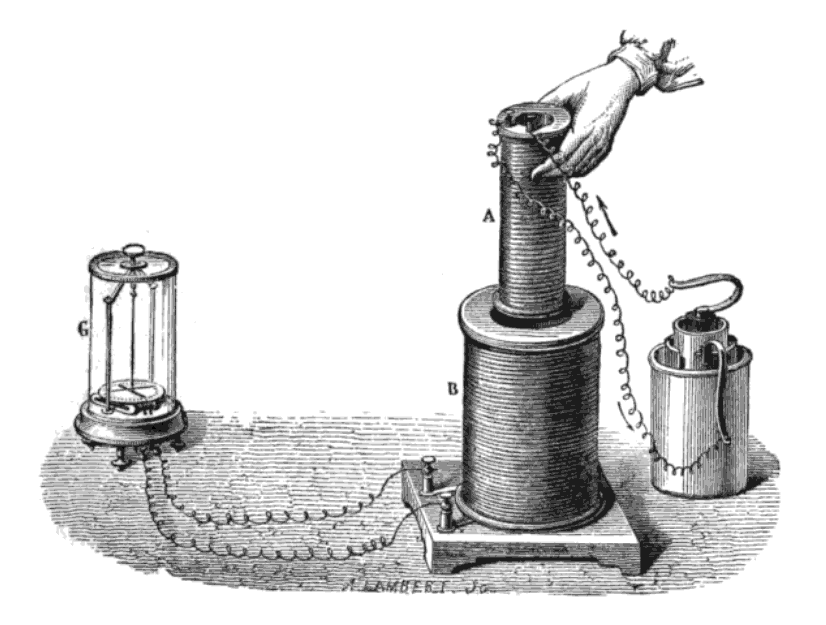 |
| Drawing of Faraday's 1831 Experiement |
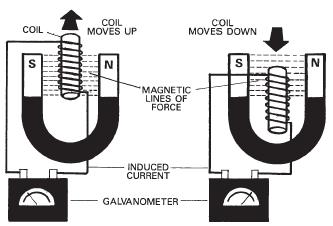 |
| Diagram of Electromagnetic Induction |
1836 -The Daniell Cell
John Frederic Daniell (12 March 1790 – 13 March 1845) was the first man to create a battery to use two separate solutions, the Daniell Cell. The cathode and the anode each had a different solution covering them resulting in a longer-lasting charge and more voltage. (http://curiosity.discovery.com/question/what-is-daniell-cell-battery, http://www.emedicalprep.com/study-material/chemistry/electro-chemistry/nernst-equation-daniells-cell.html)
Cathode: Cu2+ + 2e- -> Cu
Anode: Zn -> Zn2+ + 2e-
Combine these reactions to get the full redox reaction: Cu2+ + Zn -> Cu + Zn2+
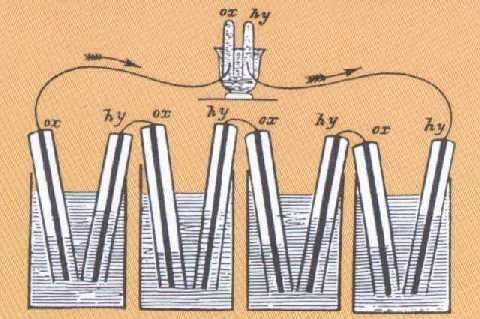 |
| The Grove Cell (diagram) |
 |
| Daniell Cell diagram |
1844- The Grove Cell
William Grove's battery, the Grove Cell, put a porous item or a salt bridge in between the two solutions increasing the flow of electrons and allowing for a larger voltage output. The battery design was loved for use in telegraphs. Here is the relevant reaction for the cell:
2H2 + O2 -> 2H2O + ENERGY
Be aware that the electrolytes were dissolved in Sulfuric Acid (H2SO4).
1859 - Lead-Acid Battery
The battery created by Gaston Plante, the lead acid battery, consisted of two strips of lead separated by cloth and immersed in an acidic solution. Uses of this battery are quite diverse and include applications in transportation and lighting. The equations are as follows:
Anode reaction: Pb + SO42- -> PbSO4 + 2e-
Cathode reaction: PbO2 + SO42- + 4H+ + 2e- -> PbSO4 + 2H2O
Therefore the full reaction is
Pb + PbO2 + 2SO42- + 4H+ -> 2PbSO4 + 2H2O
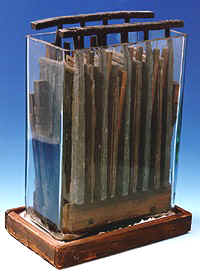 |
| Lead-Acid Battery |
 |
| Leclanche Cell diagram |
1866 - The Leclanche Cell
The battery created by Georges Leclanche was widely used in telegraph systems at the time. It was made of a crushed manganese and a zinc rod immersed in ammonium chloride. It required little maintenance which is why it was a popular choice for telegraphs.
Here are the reactions:
Cathode: 2MnO2(s)+ 2NH4+(aq) + 2e- -> Mn2O3(s) + 2NH3(aq) + 2H2O(l)
Anode: Zn(s) -> Zn2+(aq) + 2e-
Add the two equations to get the full reaction, where the anode is dissolved in Chloride ions:
2MnO2(s) + 2NH4Cl(aq) + Zn(s) -> Mn2O3(s) + 2NH3(aq) + Zn(NH3)2Cl2(s) + H2O(l)
1899 - The Nickel-Iron Cell
Invented by Ernst Waldemar Jungner (June 19, 1869- August 30, 1924), this battery was used often in cars in the early 20th century and was claimed by Edison to be “Far superior to batteries using lead plates and acid”. The cathode is NiO or Ni(OH)
and the anode is Fe. The duration of one such battery is roughly 50 years, and unlike lead-acid storage batteries, these are not susceptible to overcharge.
2
The half-reactions are as follows:
Cathode: Ni2+ + 2e- -> Ni
Anode: Fe -> Fe2+ + 2e-
Therefore the full reaction is:
Ni2+ + Fe -> Fe2+ + Ni
| Nickel-Iron Cell |
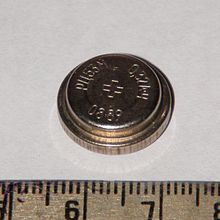 |
| Mercury Cell |
1942 - The Mercury Cell (further developed in 1942)
In 1942, Samuel Ruben (14 July 1900 - 16 July 1988) made the Mercury Cell, having already been known for a hundred years, more widely used and balanced. This battery could be built very small and provided enough energy to power small electronic devices. It was used commonly in walkie-talkies and similar devices.
The two half reactions are as follows:
Cathode: HgO(s) + H2O(l) + 2e- -> Hg(l) + 2OH-(aq)
Anode: Zn(s) + 2OH-(aq) -> Zn(OH)2(aq) + 2e-

Therefore the full reaction is
HgO(s) + H2O(l) + Zn(s) -> Hg(l) + Zn(OH)2(aq)
1946 - The Nickel-Cadmium Cell (first production of)
First developed in 1899 by Ernst Waldemar Jungner, this battery did not achieve popularity until 1946 when it went through its first production in the United States of America. These batteries are easily rechargeable and are widely used in a variety of devices such as ACs and locomotives. They still see use today, despite not being the most modern variation of the battery.
2Ni(OH)2 + Cd(OH)2 -> 2NiOOH + Cd + 2H2O
1970 - The Lithium Cell (first sold)
Gilbert Newton Lewis (October 23, 1875 – March 23, 1946) began experimenting with lithium cells in 1912, and the first lithium batteries were sold in 1970. The anode is obviously Lithium (or a Lithium alloy), and the cathode is often Manganese (IV) Oxide. The relevant reaction (excluding the spectator ion O2-) is
4Li + Mn4+ -> 4Li+ + Mn
 |
| Nickel-Cadmium Cell |
